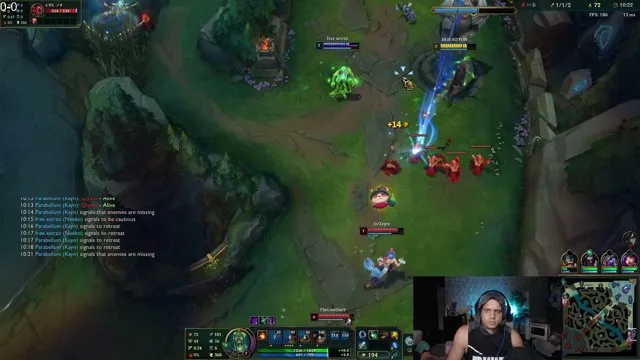
How to Stop Tilting in League of Legends

Tilt is a decision problem, not a mood. Use a stop rule before you queue, a mental reset during the game, and a short review after every loss.


You stop tilting in League of Legends with routines, not willpower. Decide your limits before you queue, cut off what feeds tilt during the game, and replace the instant requeue with a short review. Tilt is a predictable shift in how you make decisions, so you can plan around it.

The fixes are small and mechanical on purpose. You set a stop rule while calm, mute chat at load-in, reset after each death, and review instead of queueing again. Each step targets a specific way tilt costs you games.

Key takeawayTilt is a decision problem

Fix tilt with rules you set while you are calm, not with willpower in the moment.

  1. Set a loss limit and a session end before your first game, and obey it even when the next game feels winnable.
  2. Mute all at load-in and answer every death by naming the next objective, not the player who caused it.
  3. After a loss, review your own key death before you decide whether to queue again.

What tilt does to your decisions

Tilt narrows your attention and speeds up your decisions right when the game needs the opposite. After a bad death or a flame message, you start playing to feel better instead of to win. You want the kill back, you want to prove a teammate wrong, or you want the game over fast.

You rarely notice tilt from the inside. You notice what it does: you stop checking the minimap, push without vision, and take fights your champion cannot win at that item timing. Low elo players usually feel tilt as anger. High elo players more often feel it as autopilot, which is quieter and just as expensive.

Common tilt patterns

  • The revenge play. Your laner kills you, so you walk back and force the same trade before your item spike, often into the same jungler.
  • Autopilot. You stop thinking about wave state and farm whatever is in front of you. You miss roams, recall timings and objective setups.
  • The blame loop. You watch a teammate’s mistakes instead of your own map. You type between deaths and react late to fights.
  • The early forfeit. You decide the game is lost and stop playing for the late game, even when your team composition scales better.

These look different, but they share one cause: you are reacting to the last event instead of planning the next one. That is why every fix below points you forward, to the next wave, the next objective or the next game.

Why tilt compounds across games

Tilt does not end when the Nexus falls. Requeue straight after a frustrating loss and you carry the same narrow focus into champion select. You are then more likely to argue over roles, first-time a counterpick or dodge out of frustration. That is how a single loss becomes a loss streak.

Your rank reflects the average quality of your decisions across many games, not any single game. A solid plan for how to climb protects that average by ending sessions before your decision quality drops.

Before the game: limits and warm-ups

The cheapest time to beat tilt is before you queue, because you set your limits while you are still calm. A rule you make mid-session always loses to the voice that says one more game will fix it.

Set a stop rule before your first game

Decide in advance what ends your session. That can be a loss limit, an end time, or a warning sign you can name, such as typing in chat or wanting to dodge. Write it down somewhere you will see it between games. The rule only works if you cannot negotiate with it once the session starts.

Pick the limit that matches your history. If your worst sessions start with back-to-back losses, use a loss limit. If they start when you are tired, use an end time. Ranked Solo/Duo is where tilt costs you LP, so once you hit your limit you can still play Swiftplay or ARAM for fun.

Warm up your hands and your head

A warm-up tells you how you are playing today before it costs you anything. If last-hitting feels off or your combos are slow, find out in Practice Tool, not in a lane where one missed cannon starts the frustration.

Your champion choice is part of the warm-up. A small, practiced pool means fewer unfamiliar matchups and fewer moments where you feel helpless. Building a champion pool shows you how to choose one that holds up when you are under pressure.

Pre-game drills

  1. Last-hit warm-up in Practice Tool. Farm a few waves on your main champion with no items. Goal: no missed cannon minions before you queue.
  2. Write your stop rule. Before each session, write your loss limit and end time on paper. Goal: every session this week ends at or before the written limit.
  3. Pre-game intention. In champion select, name one focus, such as tracking the enemy jungler or crashing the wave before each recall. Goal: after the game, you can say yes or no to whether you did it.
  4. Mood check. Before you press Find Match, rate yourself calm, neutral or frustrated. Goal: you never start a ranked game rated frustrated.
TipOnly queue with time to spare

Start a ranked game only when you have time to finish it. If you might have to leave early, you feel rushed from the opening wave, and that pressure feeds tilt.

How to stop tilting mid-game: mute all and the next objective

During the game, you stop tilting in two steps. First, remove what triggers it, which is what muting does. Second, give your attention a forward target by naming the next objective.

Mute all at load-in, not after the flame

Type /mute all in chat on the loading screen every game, before anything goes wrong. If you wait until someone flames, you have already read the message and your focus has already taken the hit. Mute first, and unmute later only if the game gives you a reason.

Muting also stops you from typing. Every message you write is time you are not watching the map, and a chat argument almost never changes how a teammate plays. When you need to say something, ping timers and objectives instead.

The mental reset after a death

The grey screen after a death is where tilt either starts or stops, so use it for a fixed mental reset. Breathe out slowly. Name what killed you in a few words. Then name the next objective your team can play for.

Make the objective concrete: the next Dragon, Voidgrubs, a turret your side lane can take, or the wave you need to catch before it crashes under your tower. If you cannot name one, scan the map until you can. Good minimap awareness makes that scan quick, and it keeps you thinking about the next event instead of the last one.

Play to your win condition, not to get even

When you are behind, the revenge play feels right and is usually wrong. Take a K’Sante who loses lane to Jayce. Forcing another trade at the same item disadvantage gains him nothing. He wins by holding the wave near his tower, waiting for his jungler and showing up for the teamfights where a frontline matters.

Ask yourself what your champion does well from this point, then play toward it. Run this checklist whenever you respawn or recall:

  • Chat is muted and I am not typing.
  • I can name the next objective and when it spawns.
  • I know where the enemy jungler was last seen.
  • My wave is in a safe state before I recall or roam.
  • I am not about to force a fight because of my last death.
  • I am playing for my team’s win condition, not my lane’s score.
Watch outSurrender votes are a tilt trigger

Voting yes early makes you stop playing for the late game, even when the vote fails. Vote based on the map, not on how the last fight felt, and keep playing for the next objective either way.

After a loss: review, not requeue

What you do in the first few minutes after a loss matters most. Requeueing right away carries the frustration into champion select. A short review turns the loss into something you can use.

The diagram below shows the two roads out of a loss. On the first, an instant requeue lets each loss feed the next game. On the second, a short review and a break leave the loss behind before you queue again.

Two roads out of a loss. The spiral: requeue, a tilted game, another loss, and back to requeue. The reset: a ten-minute review, a break, then the next game fresh.
Two roads out of a loss: the requeue spiral, or a short review and a break before the next game.

A short post-loss review

Keep the review short and specific. You are not rewatching the whole game. You are looking for one decision you would change and turning it into a focus for next time. The full method is in how to VOD review.

  1. Stand up, get water and step away from the screen before you open anything.
  2. Open the replay and jump to the death or fight that felt most decisive.
  3. Watch the lead-up and ask what you knew at the time: wave state, enemy jungler position, cooldowns.
  4. Write one sentence: the decision you would change and what you would do instead.
  5. Carry that sentence into your next game as your pre-game intention.

Reviewing your own death is where blame turns into learning. Even when a teammate’s play decided the game, your position, recall or vision usually made it worse at some point. That moment is the only part you control.

Breaking a loss streak

A loss streak is usually a tilt streak. When your stop rule triggers, end the ranked session, even if you feel fine. If you still want to play, switch to a mode where the result does not count, or watch high elo games instead.

Watching strong players is a good break because you keep learning without risking LP. The streamers and pro players hub has games from Deft, loltyler1 and Burdol. Pick one on your role and watch it with a single question from this guide in mind.

Deft's Caitlyn vs Jhin, Grandmaster, 18 May 2025Watch for: after each fight, is Caitlyn's next move aimed at an objective or at getting even?Deft Caitlyn vs Jhin

loltyler1's Brand vs Yunara, Challenger, 8 Oct 2026Watch for: each time Brand recalls, name the next objective yourself, then check whether he plays toward it.loltyler1 Brand vs Yunara

Burdol's K'Sante vs Jayce, Grandmaster, 6 Oct 2026Watch for: is K'Sante's wave in a safe state before every recall or roam?Burdol K'Sante vs Jayce

Treat each game as a review exercise, not entertainment. Pause at each fight or reset and ask what the player is focused on next. Then compare that with what you would have done in the same spot.

Common tilt mistakes

Most tilt problems come from a handful of habits that feel reasonable in the moment.

  1. Requeueing to win it back

    Why it happens
    The loss feels unfinished, and the next game promises quick relief.
    The fix
    Do the short review first, and queue again only if your stop rule allows it.
  2. Muting only after the flame

    Why it happens
    You expect a calm game, so you mute in reaction instead of in advance.
    The fix
    Type /mute all on the loading screen every game, before anything happens.
  3. Raising the loss limit mid-session

    Why it happens
    The next game always feels winnable once you are already in the session.
    The fix
    Write the limit down before your first game and treat it as fixed.
  4. Typing to correct teammates

    Why it happens
    You want the mistake acknowledged, and typing feels like doing something about it.
    The fix
    Ping the objective instead and keep your eyes on the map.
  5. Reviewing only your teammates’ mistakes

    Why it happens
    Their errors are easier to spot and protect your ego.
    The fix
    Review your own key death and write down one change you would make.
  6. Trying new champions while tilted

    Why it happens
    A fresh pick feels like a fix for a run of losses.
    The fix
    Stay on your practiced pool in ranked and test new picks in normal games.

Putting it into practice

At first, change only what you do before and after games. In your next session, write your stop rule, mute all at load-in, and replace every requeue after a loss with the short review.

Once those habits feel automatic, add the mental reset after each death and the mid-game checklist. Pair them with the rest of our fundamentals guides so every review has something specific to look for.

Frequently asked questions

What is tilt in League of Legends?

Tilt is a frustrated or emotional state that changes how you make decisions. In League of Legends it shows up as revenge plays, autopilot farming, arguing in chat and requeueing after losses. It matters because it lowers the quality of your decisions across a whole session, which is how one bad game turns into a loss streak.

Should I use mute all every game?

Yes. For most players, muting all chat on the loading screen is the simplest way to prevent tilt. You can still use pings for objectives and timers, you lose very little useful information, and you never read the flame that would break your focus. Organized teams with voice comms are the main exception.

How many games should I play before taking a break?

There is no universal number, so set your own stop rule before your first game. Use a loss limit if your worst sessions start with back-to-back losses, or an end time if they start when you are tired. The rule only works if you write it down in advance and never raise it mid-session.

How do I break a loss streak in ranked?

Stop queueing ranked once your stop rule triggers, even if you feel fine. Review one key death from the last loss, write down the decision you would change, and take a real break. Return to ranked later with that note as your focus, and play only champions from your practiced pool.

Do high elo players tilt too?

Yes. High elo players tilt, but it often looks like autopilot rather than anger: missed timers, careless wave states and fights taken out of habit. The usual fixes are simple routines, such as fixed session limits, muted chat and reviewing their own deaths instead of blaming teammates for the loss.

Sources

  1. Riot Games: How to play League of Legends

See these fundamentals in high-elo VODs

  • Jump straight to any moment: kills, objectives, teamfights
  • See the exact build path and rune page at every minute
  • Thousands of pro and Challenger VODs, updated daily
Champion pages
Free · Windows · no account needed