Minimap Awareness in League of Legends: Read the Map

Most deaths to ganks come from information that was already on your minimap. This guide builds the 3-second habit and shows how to turn each glance into a decision.

Minimap awareness in League of Legends means glancing at the minimap on a fixed rhythm, about every 3 seconds, and turning what you see into a decision before you look back at your champion. You are not trying to watch the whole map. You check three things: which enemies are missing, where vision exists, and where the enemy jungler was last seen.

Key takeawayThe short version

Map awareness is a habit tied to triggers, not a talent you either have or lack.

  1. Glance at the minimap after every last hit, every ability cast and every time a wave crashes.
  2. Treat a missing icon as information: an enemy you cannot see is an enemy who might be walking toward you.
  3. Every glance ends in a decision (push, hold, back off or rotate), even if the decision is to keep farming.

Why you die to things you could have seen

Most surprise deaths are not surprises. The enemy jungler showed on a ward, the mid laner left lane, or your side of the river went dark, and the warning sat on your minimap while you were staring at a last hit. The information existed. You just looked at it too late or not at all.

Picture yourself on Caitlyn, shoving the wave into the enemy tower. Your support warded the river bush earlier, but that ward has expired. The enemy jungler cleared their top side camps a while ago and has not been seen since. Nothing on the screen looks dangerous, yet every piece of the gank was readable from the minimap: a jungler heading your way, no vision covering their approach, and a wave that leaves you deep in their half.

Tunnel vision is the real problem

Players in low elo usually know the minimap matters. They forget to look because lane demands constant attention: last hits, trades, cooldowns, the enemy laner’s position. The more mechanically demanding your champion or matchup, the stronger the pull to stare at the center of the screen. That is why awareness has to be a scheduled habit rather than something you remember to do.

What the minimap can and cannot tell you

The minimap shows what your team can see right now, plus the last-known positions of enemies who have walked into fog. It cannot show intent. A jungler visible at their raptors is not a threat this second, but the same jungler missing a few moments later could be anywhere within walking range. Good players read both the icons and the gaps between them.

The 3-second habit

The habit is simple: look at your screen, glance at the minimap, make a decision, and return to your screen. The glance itself is short. What makes it work is the rhythm, roughly every 3 seconds, so no enemy movement goes unnoticed for long. The diagram below shows the loop.

A loop of three steps repeated every three seconds: the screen for the wave, their health and your cooldowns; the minimap for who is missing and where their jungler is; then a decision to stay, step back or go before looking back at the screen.
The 3-second habit: screen, minimap, decision, and back to the screen.

Tie glances to triggers

Counting seconds in your head does not survive a real game. Triggers do. Attach a minimap glance to actions you already perform dozens of times: right after you last-hit a minion, right after you cast an ability, when the wave crashes into a tower, and when you start walking back to lane after a recall. These moments are natural pauses where looking away costs you nothing.

After a few games of forcing it, the glance becomes automatic. That is the goal. You want your eyes to flick down without a conscious thought, the same way you check your health bar before a trade.

When the habit breaks

During an all-in or a teamfight, you cannot look away. The fix is to look before you commit. If you plan to go for a kill at level 6, check the minimap right before you engage, confirm the enemy jungler’s last position, and then play the fight with full attention. Mechanically heavy champions in tense lanes need more pre-commit checks, not fewer.

TipMake the minimap easier to read

Increase the minimap size in the interface settings until you can identify champion portraits at a glance. A larger map makes each glance faster, which makes the habit cheaper to keep.

What to look for: missing lanes, wards and the jungler

A glance is only useful if you know what to look for. Run the same three checks every time: which lanes are missing a champion, where your vision is and is not, and where the enemy jungler was last seen. Everything else is detail.

Missing lanes

Count the enemy icons in lane. If the enemy mid laner disappears right after shoving the wave into your mid laner’s tower, that is the classic setup for a roam. Champions with global or long-range pressure, such as Twisted Fate with his ultimate, deserve extra attention because they can arrive from much further away. If you play the roaming side yourself, our guide on how to roam covers the same signals from the other direction.

A missing laner is not always a threat. If their wave is crashing into their own tower, they may simply have recalled. Check the wave state before you decide: a laner who left a big wave to die under their own tower is much more likely to be roaming than one who just cleared it.

Wards and vision gaps

Your wards tell you where enemies cannot surprise you. Their absence tells you where they can. Know which wards your team placed, notice when they expire, and pay attention when an enemy ward reveals itself or a ward of yours gets cleared, since a cleared ward often means someone is preparing to walk through that space. Our warding guide covers where to place vision; here, the skill is reading it.

Jungle tracking

Jungle tracking turns one sighting into a prediction. When the enemy jungler shows at a camp, you know roughly which side of the map they are on and which camps they will clear next. A Lee Sin seen at his top side buff early is unlikely to appear at bot lane in the next few moments, which gives bot lane a window to trade hard. Learning common routes from our jungle pathing guide makes these predictions much sharper.

Missing camps help too. If you see a camp has been taken but never saw the jungler, they passed through recently and the closest lanes are under threat. Scuttle Crab fights, a laner suddenly playing aggressive, or an enemy laner hovering near the river bush are also tells that the jungler is close.

  • Count enemy icons in lane: who is missing, and is their wave pushing toward you or away?
  • Check the enemy jungler’s last-known position and which camps should be next on their route.
  • Scan your nearest river and jungle entrances: are your wards still up?
  • Look at your own wave: are you pushed up without vision covering your escape?
  • Note your team’s positions: who can help you, and who you could help?

Turning information into decisions

Information is only worth something if it changes what you do. Every glance should end in one of a small set of decisions: keep pushing, hold the wave, back off, rotate to help, or contest an objective. Often the answer is “keep farming,” and that is fine, as long as it is a choice and not a default.

In lane

If the enemy jungler just showed on the opposite side of the map, you have a safe window. Use it to trade aggressively, take plates or push the wave and recall. If the jungler is missing and your river ward is gone, stop walking forward. Last-hit from a safer position, let the wave come to you, and only step up again once the jungler shows somewhere else.

Top laners on champions like K’Sante can use this the same way: when the enemy jungler appears bot side, it is the moment to push and set up a dive or a recall, not the moment to wait around.

Mid and late game

Once lanes break, the minimap decides fights before they start. If several enemies are missing and Dragon or Baron Nashor is about to spawn, assume they are grouped near it. Do not walk into the dark alone to ward. Group with your team or trade across the map by pushing a side lane while they commit. If you see most of the enemy team on one side, the other side of the map is yours to take.

Watch outDo not over-respect every gap

A missing icon is a risk, not a certainty. If you back off every time an enemy leaves vision, you lose waves, plates and pressure for nothing. Weigh the gap against the information you have: the jungler’s last position, the wave state and your own escape options.

Common mistakes with map awareness

These are the errors we see most often, from low elo through high elo.

  1. Looking only after you are in trouble

    Why it happens
    Lane feels busy, so players check the map only when they hear an alert or see a ping.
    The fix
    Tie glances to triggers such as last hits and ability casts so you see threats before they arrive.
  2. Seeing an icon without making a decision

    Why it happens
    Players notice the information but treat the glance as passive, then keep doing what they were doing.
    The fix
    End every glance with a verb: push, hold, back off or rotate.
  3. Forgetting the jungler after one sighting

    Why it happens
    A single sighting feels like enough, but the jungler keeps moving after leaving vision.
    The fix
    Predict their next camps from the sighting and update the prediction each time you glance.
  4. Ignoring your own wave state

    Why it happens
    Players focus on enemy positions and forget that a pushed wave puts them deep with no escape.
    The fix
    Include your own wave in every check; if you are pushed without vision, play the gank as already coming.
  5. Panicking at every missing enemy

    Why it happens
    After a few gank deaths, players overcorrect and treat every gap as a guaranteed threat.
    The fix
    Check wave state and last-known positions first; back off only when the gap and the situation both point to danger.

Drills

Map awareness improves fastest when you practice it on purpose for a few games at a time. Run one drill per session so you can focus on a single habit.

  1. Last-hit glance (Practice Tool): farm a wave and glance at the minimap after every last hit. Goal: a full wave cleared without skipping a single glance.
  2. Jungler callout (normal games): every time the enemy jungler appears on the minimap, type or say where they are and where they are likely going next. Goal: never go a full game section without an updated jungler position.
  3. Missing icon count (normal games): each time a wave crashes, count the enemy champions you can see. Goal: name who is missing at every crash for a whole game.
  4. Pre-commit check (normal games): before every all-in or tower dive, glance at the minimap first. Goal: no deaths in a game to an enemy you did not check for.
  5. Decision log (VOD review): rewatch one of your games and pause at each death. Goal: for every death, identify the last moment the minimap showed the threat.

The last drill works best with a structured method, which our guide on how to VOD review walks through. You can also apply the same checks to high-elo games from our library of streamers and pro players. Pick one game below and pause whenever a lane goes quiet to ask what you would decide.

Deft's Caitlyn vs Jhin, Grandmaster, 18 May 2025Watch for: before each push toward the enemy tower, does the player check the enemy jungler's last position?Deft Caitlyn vs Jhin

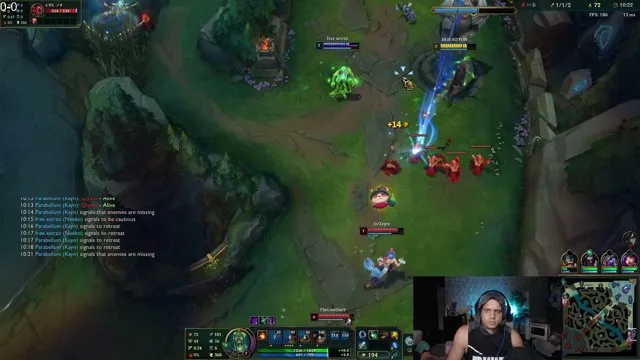
loltyler1's Brand vs Yunara, Challenger, 8 Oct 2026Watch for: when an enemy leaves vision, pause and decide whether you would push, hold or back off.loltyler1 Brand vs Yunara
Burdol's K'Sante vs Jayce, Grandmaster, 6 Oct 2026Watch for: at each wave crash, count which enemy champions are visible on the minimap.Burdol K'Sante vs Jayce

Putting it into practice

Start next game with one trigger only: glance at the minimap after every last hit. Once that feels automatic, add the pre-commit check before fights, then jungle tracking. Do not try to fix everything at once.

After each game, ask one question about every death: was the threat on the minimap before it reached you? If the answer keeps being yes, the habit needs more reps. If the answer starts to be no, move on to improving vision with the warding guide so there is more to read.

Frequently asked questions

How often should you look at the minimap in League of Legends?

Aim for a glance roughly every 3 seconds. Rather than counting, tie the glance to actions you already repeat, such as last-hitting a minion, casting an ability or a wave crashing. These triggers create a steady rhythm without pulling focus from lane, and after a few games the habit becomes automatic.

What should you look for on the minimap?

Run three checks every glance. First, count enemy laners and note who is missing. Second, check where your wards are and which have expired. Third, find the enemy jungler’s last-known position and predict their next camps. Then decide whether to push, hold, back off or rotate before looking back at your champion.

How do you track the enemy jungler?

Use every sighting to predict their route. When the jungler appears at a camp, you know which side of the map they are on and which camps come next. Missing camps, Scuttle Crab fights and suddenly aggressive laners also hint at their position. Update the prediction each time you glance at the minimap.

Why do I keep getting ganked even when I check the map?

Usually because you check without deciding. Seeing a missing jungler only helps if you change your position, hold the wave or back off. Also check your own wave state: a pushed wave with no river vision leaves you exposed. End every glance with a clear action instead of continuing on autopilot.

How do you practice map awareness?

Run one drill per session. In Practice Tool, glance after every last hit for a full wave. In normal games, call out the enemy jungler’s position every time it appears, or count missing enemies at each wave crash. Afterward, review your deaths and find the last moment the minimap showed the threat.

Sources

  1. Riot Games: How to play League of Legends

See these fundamentals in high-elo VODs

  • Jump straight to any moment: kills, objectives, teamfights
  • See the exact build path and rune page at every minute
  • Thousands of pro and Challenger VODs, updated daily
Champion pages
Free · Windows · no account needed