How to Teamfight in League of Legends: Positioning

Most teamfights are decided before the first spell. Learn the four win conditions, how to position around threat ranges, who to hit, and your job by class.

To teamfight well in League of Legends, decide your team’s win condition before the fight, stand where the enemy’s biggest threat cannot reach you, and spend your damage on the most valuable target you can reach safely. Mechanics win duels. Positioning, target choice and timing win teamfights, and most fights are lost by the player who walks in from the wrong angle, not the one who misses a skillshot.

Key takeawayRemember these rules

Every teamfight is won by the team that knows its job before the first ability is cast.

  1. Pick one win condition before the fight (front to back, pick, dive or siege) and play only for that one.
  2. Stand outside the reach of the enemy champion that can kill you, measured from their dash and Flash, not their basic attack.
  3. Hit the most valuable target you can reach safely, and switch only when a priority target walks into your range.

Why most teamfights are decided before they start

The team that wins a teamfight usually won it before anyone cast a spell. Vision, numbers, cooldowns and item timings set the odds, and the fight mostly cashes them in. If you walk into a fight down a player, without Flash, or into an unwarded jungle, mechanics rarely save you.

Worlds is the clearest place to see this. The fights that look chaotic on the broadcast tend to follow a quiet setup phase: one team clears wards around the objective, pushes the side waves and waits for a key enemy cooldown before committing. When you rewatch a pro teamfight, start earlier than the first engage and the result usually stops looking random.

The pre-fight questions

  • Numbers: is anyone missing, dead or split pushing far away? A fight with a player advantage is the easiest win in the game.
  • Vision: who controls the area you will fight in? Fighting inside your own wards means you see the engage coming; fighting inside theirs means you do not. Our warding guide covers how to build that control.
  • Cooldowns: are the enemy’s engage ultimate, Flash or Teleport down? A fight right after the enemy loses a key tool is a different fight.
  • Items and levels: who just hit a power spike? A completed item or an ultimate rank-up can flip a fight that looked even moments earlier.
  • Waves: which side waves are pushing toward whose base? The team with waves crashing into enemy turrets can fight longer, because the other side loses gold and structures while it fights.

If most answers favor you, look for the fight. If most favor the enemy, give up the objective cheaply and take something elsewhere. Saying no to a bad fight is a teamfighting skill, not a lack of one.

Win conditions: front to back, pick, dive and siege

Every team composition has one main way it wants to fight, and your job is to play for that one rather than a mix. The common shapes are front to back, pick, dive and siege. The diagram below shows the formation each one asks of your team.

Four small panels of two teams as dots. Front to back: one line pushes at the nearest enemies. Pick: two arrows converge on one isolated enemy. Dive: an arrow arcs over the enemy frontline onto their carries. Siege: dashed arrows poke toward a tower before taking it.
Four win conditions: front to back, pick, dive and siege, and the shape each asks of your team.

Front to back

Front to back means your frontline absorbs the enemy engage, your carries hit whoever is closest, and the fight is won by sustained damage over time. It suits compositions with a tank, a scaling marksman and an enchanter, such as Ornn, Jinx and Lulu. Nobody dives; the backline walks forward only as the enemy frontline melts.

This shape wins when your carries out-damage the enemy over a long fight and the enemy cannot reach them. It breaks when the enemy has more reach than you have peel, or when a carry face-checks a bush and gets caught before the fight begins.

Pick

A pick composition wins by catching one player alone and fighting with a player advantage. Champions with long-range crowd control, such as Ahri, Thresh, Blitzcrank and Morgana, threaten anyone who walks through fog without vision. These teams want the map dark and the enemy spread out, so they live in river and jungle with Oracle Lens, clearing wards and waiting.

Pick compositions often lose a straight front-to-back fight. If you play one, do not stand in the middle of river waiting for the enemy to group; make them walk through your zone to reach the objective.

Dive

Dive means several of your champions jump past the enemy frontline together and kill the carry before they can act. Vi, Camille, Diana and Akali want this. The key word is together: one diver going in alone is a feed, while a coordinated dive collapses a backline in a single rotation of cooldowns.

Dive breaks against heavy peel. If the enemy keeps Cleanse, Exhaust or a disengage support like Janna next to their carry, wait for those tools to be spent before you commit.

Siege

Siege compositions win without a full fight. Long-range poke and wave clear from champions like Caitlyn, Jayce, Xerath, Ziggs and Varus chip turrets and enemies until the defenders either give up the tower or engage at a health deficit. Keep the wave in front of you and back off the moment the enemy walks forward at full health.

Siege falls apart when the enemy has hard engage and you stand too close, or when your poke keeps missing and you keep sieging anyway.

Reading which one you have

Check your draft on the loading screen: count your engage tools, your range and your peel, then compare them with the enemy’s. If you are unsure what a champion brings, look it up on our champion pages. When your composition fits more than one shape, pick the one the enemy is worst at defending and tell your team in one short message.

Good to knowWin conditions can change mid-game

A pick composition that falls behind often turns into a siege team, and a front-to-back team with a fed diver can start diving. Re-ask the question after every major item spike, not just in the loading screen.

Your job in the fight: teamfight roles by class

Your class decides your job far more than your lane does. A support Brand and a mid Brand have the same job once the fight starts, and a top K’Sante and a jungle Vi want very different things.

Tanks and engage supports

You start fights or stop them. Engage on the target that leaves your carries the shortest walk to a kill, usually the enemy carry or the player standing furthest forward on a flank. After the engage, stay between your carries and the enemy divers; a tank who chases the enemy marksman across the map has left their own backline open.

Fighters and bruisers

Fighters like K’Sante, Camille or Darius either frontline or flank, depending on the composition. In a front-to-back team you are a second frontline: walk forward, take space and threaten whoever is closest. In a dive team you flank from the side and arrive after the enemy has spent crowd control on someone else.

Assassins

Assassins want the fight to start without them. Wait in fog on a flank until the enemy uses their peel, then enter on the carry. If you show yourself first, the enemy holds crowd control for you and you die before reaching anyone.

Mages

Control and battle mages such as Brand, Orianna and Syndra win fights with area damage and crowd control. Your best spells hit several champions at once or lock down a diver who reached your carry. Do not spend your full rotation on a tank at the front unless that tank is the enemy’s engage threat.

Marksmen

Your job is to stay alive and deal damage every second the fight lasts. Hit the closest safe target, move between attacks and never walk past your frontline to reach a better target. A marksman who survives the whole fight with modest damage beats one who dies after a few attacks.

Enchanters

Enchanters like Lulu, Janna and Milio protect the player most likely to win the fight, usually the marksman. Hold your shields and crowd control for the diver who reaches your carry instead of spending them on the first enemy you see.

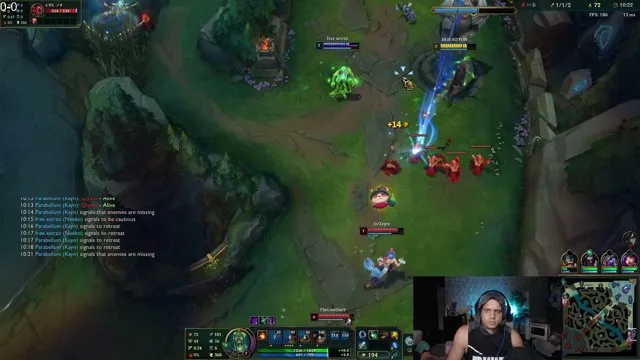
Three of these jobs are in MID.GG’s high-elo library from the player’s own camera: Deft on Caitlyn, loltyler1 on Brand and Burdol on K’Sante. Choose the one closest to your role and watch it with this section’s job description in mind; you can find more players on our streamers and pro players page.

Deft's Caitlyn vs Lucian, Challenger, 18 May 2025Watch for: does Caitlyn hit the closest safe target, or step past her frontline to reach a better one?Deft Caitlyn vs Lucian

loltyler1's Brand vs Kog'Maw, Grandmaster, 8 Oct 2026Watch for: does Brand save his area spells for several champions or a diver instead of the tank?loltyler1 Brand vs Kog'Maw
Burdol's K'Sante vs Jayce, Grandmaster, 6 Oct 2026Watch for: after K'Sante engages, does he stay between his carries and the enemy divers?Burdol K'Sante vs Jayce

Teamfight positioning and threat ranges

Good teamfight positioning means standing where you can deal damage but the enemy’s most dangerous champion cannot reach you. That spot depends on the enemy’s threat range, not your own attack range. The diagram below shows the pocket: carries behind the frontline and outside the diver’s reach, the space the enemy cannot touch.

A front-to-back fight. Your frontline stands between the teams, your carries behind it in a shaded safe pocket. A dashed circle around the enemy diver marks the reach that covers your frontline but not the pocket.
Carries stand behind the frontline and outside the diver’s reach: the pocket the enemy cannot touch.

Threat range is longer than attack range

A champion’s threat range is everything it can reach right now: dashes, Flash and ability range added together. A Vi with her ultimate and Flash available threatens far more ground than her basic attack suggests. When you choose where to stand, measure from the enemy’s longest gap closer, not from their autos.

This is why cooldown tracking and positioning are the same skill. Once the enemy’s engage tool is used, their threat range shrinks and you can step forward. While it is up, the pocket you can safely stand in is smaller.

Fog of war is threat range you cannot see

Any enemy you cannot see might be anywhere their movement allowed since you last saw them. Before you walk to the front of your team, check the minimap for missing enemies. If their assassin has not shown for a while, assume they are on the flank you just walked toward.

Angles and flanks

Carries want to stand behind the frontline and slightly to the side, so a straight engage hits the tank first. Flankers want the opposite: an angle from the side or behind where the enemy frontline is not between them and the carry. In narrow jungle corridors, spread out so one area ultimate cannot hit everyone; in open river, group tighter so your peel can reach the carry in time.

TipHover at the edge

While the enemy’s best engage tool is available, stand at the very edge of its reach and attack whatever you can hit from there. Step in only after it has been used, and step back out the moment it returns.

Target selection and cooldown tracking

Target selection in League of Legends comes down to one rule: hit the most valuable target you can reach safely. For most carries that is the closest enemy; for divers and assassins it is the enemy carry once their peel is spent.

Closest target versus priority target

Marksmen and mages in a front-to-back fight should hit the frontline if that is all they can reach. Damage on a tank is not wasted: it shortens the fight and forces the enemy backline to walk forward to protect it. Switch to the enemy carry the moment they step into your range, then switch back if they leave.

The trap is the carry who sees the enemy marksman behind the tank and walks forward to reach them. You give up your position, step into the threat range of every enemy champion, and usually die before your target does.

Who to focus as a diver

If you dive, take the target that ends the fight: the fed carry, or the enchanter keeping that carry alive. Killing the support first sometimes wins the fight even when the marksman survives, because the marksman is left with no protection against your next rotation.

Cooldowns that decide fights

Track the tools that change who can be killed: Flash on both enemy carries, engage ultimates, Cleanse, Exhaust and defensive ultimates like Kayle’s or Zilean’s. You do not need every cooldown, only the ones that would change your decision to fight. Our cooldown tracking guide shows how to log Summoner spells quickly in chat.

Ping a key cooldown the moment you see it used. Plenty of ranked fights are lost because only one player saw the enemy Flash go down. Practice these drills in order; each has a goal you can check after the session.

  1. Range check (Practice Tool): on your main champion, attack a target dummy at maximum range and step back between attacks without ever moving closer. Goal: a full minute of attacks without stepping inside your range edge.
  2. Flash log (normal games): whenever an enemy uses Flash, ping it and type the game time in chat. Goal: before every Dragon or Baron Nashor fight, know the Flash status of both enemy carries.
  3. Closest-target rule (normal games, carry roles): play a full game hitting only the nearest safe target and switching only when a priority target walks into range. Goal: no deaths from walking past your own frontline.
  4. Replay labels (replay review): pause your replay at the first spell of each teamfight and name your win condition, the enemy’s biggest threat range and your target. Goal: a label for every fight in the game, plus the reason you won or lost it.

Engaging, disengaging and resetting

Engage when you have an advantage you can name, disengage the moment it is gone, and reset rather than fight without your key tools.

When to engage

The best engages come from a clear trigger: an enemy out of position, a key enemy cooldown used, a player advantage, or a power spike the enemy has not matched. Without a trigger, you are flipping a coin. When your engager goes in, follow immediately; a late follow-up turns a good engage into a dead tank.

Who engages matters too. If your tank holds your only real engage, everyone else holds position until it lands. If you play a pick champion, your hook or charm is the engage, so tell your team before you throw it.

Disengaging

Disengaging means using your tools to stop a fight from starting or continuing: knock-backs, slows and simply walking out of the enemy’s threat range. Ranged compositions disengage by stepping back and hitting whoever chases. If the enemy engage lands and you are losing, peel your carry out instead of throwing your remaining cooldowns at the tank.

Resetting

A reset is a deliberate step back to wait for cooldowns or a better angle. If both teams are poking and your engage ultimate is down, back off until it returns. Pro teams often do this around Baron Nashor at events like Worlds: trade the first skirmish, walk away, recall and return with full health and items rather than force a fight at a disadvantage.

Watch outDo not chase

A kill on a fleeing enemy is rarely worth the position and time you lose. Once the enemy backline runs, take the objective or the nearest turret instead of following them into fog.

Fighting around objectives

Objective fights are won by the team that arrives first with vision and pushed waves. One team usually wants to take the objective and the other has to contest, which means walking through choke points into the attacker’s setup.

Setup before the spawn

Start preparing well before Dragon, Voidgrubs, Atakhan or Baron Nashor spawns. Push the side waves nearest the objective, recall for items, ward the enemy’s entrances and clear their wards with Oracle Lens. Our objective control guide covers the timing in detail.

Choke points and angles

Around the Dragon and Baron Nashor pits, the enemy can only arrive through a handful of jungle entrances. Stand so your area damage covers those entrances. Brand, Orianna and Ziggs in particular can decide a fight before it starts if the enemy walks through one corridor into their spells.

Contesting from behind

If you are behind, you do not need to win the objective fight; you need to make the objective expensive. Poke the team in the pit, threaten a steal with Smite and leave once your engage tools are spent. If the enemy has full vision and pushed waves, trade the objective for a turret on the other side of the map. Run this checklist before every objective fight:

  • Side waves near the objective are pushed toward the enemy.
  • Every player has recalled or has enough health to fight.
  • Our wards cover the enemy’s entrances and their wards are cleared.
  • I know whether the enemy engage ultimate and both carry Flashes are up.
  • I know our win condition and where I stand for it.
  • I know my first target and my escape path.

Common mistakes when you learn how to teamfight in League of Legends

These are the teamfight mistakes we see most in ranked, from low elo to high elo.

  1. Walking past your frontline

    Why it happens
    The enemy carry looks low or close, and greed overrides the position you are giving up.
    The fix
    Hit the closest safe target and switch only when the priority target walks into your range.
  2. Engaging alone

    Why it happens
    The tank sees an opening and assumes the team will follow without being told.
    The fix
    Ping before you go and check that your carries are close enough to follow immediately.
  3. Spending everything on the tank

    Why it happens
    The tank is the closest and most visible target, so crowd control and burst land there by default.
    The fix
    Hold your crowd control and burst for the diver or carry; use them on the tank only when the tank is the engage threat.
  4. Fighting without key cooldowns

    Why it happens
    An objective timer creates pressure to contest even when your ultimate or Flash is down.
    The fix
    Give the objective up cheaply or reset, then fight on the next timer with your tools available.
  5. Chasing fleeing enemies

    Why it happens
    A kill feels like a bigger reward than a turret or objective.
    The fix
    Once the enemy runs, take the objective or the nearest structure and recall.
  6. Ignoring side waves

    Why it happens
    Everyone groups for the fight and nobody wants to miss it.
    The fix
    Push side waves toward the enemy before grouping so the waves pressure them while you fight.

Putting it into practice

Pick one habit per session. Start with the pre-fight questions and the objective checklist, because they decide more fights than anything you do once spells start flying. When you can answer them without thinking, add the closest-target rule and the Flash log.

Compositions shift with every balance update, so check the patch notes for changes to engage and dive champions, and browse all guides for the skills that feed into your teamfights.

Frequently asked questions

What is the most important thing in a League of Legends teamfight?

Positioning is the most important skill in a teamfight. Stand where you can deal damage but the enemy’s most dangerous champion cannot reach you, measured from their dash, Flash and engage range rather than their basic attacks. A carry who stays alive the whole fight usually outdamages one with better mechanics who dies early.

Who should the ADC hit in a teamfight?

The ADC should hit the closest enemy they can attack safely, usually the frontline in a front-to-back fight. Switch to the enemy carry only when they walk into your range, then switch back if they leave. Walking past your own frontline to reach a better target is the most common way marksmen die in fights.

What does front to back mean in League of Legends?

Front to back is a teamfight style where your frontline absorbs the enemy engage while your carries damage whichever enemy is closest. The fight is won by sustained damage over time rather than burst. It suits compositions with a tank, a scaling marksman and an enchanter, and it loses to teams with more reach than you have peel.

When should you disengage from a teamfight?

Disengage when the advantage that made you fight is gone: a teammate died, your engage missed, or the enemy’s key cooldowns came back. Use knock-backs, slows and simply walking out of threat range, and protect your carry first. Taking a reset and fighting again with full cooldowns beats forcing an even or losing fight.

Should the tank always engage first in a teamfight?

No. The player with the best engage tool should start the fight, and that is often the tank but can be a pick support, a diver or a mage with area crowd control. What matters is that the team follows instantly and that the engage lands on a target your carries can actually reach.

Sources

  1. Riot Games: How to play League of Legends

See these fundamentals in high-elo VODs

  • Jump straight to any moment: kills, objectives, teamfights
  • See the exact build path and rune page at every minute
  • Thousands of pro and Challenger VODs, updated daily
Champion pages
Free · Windows · no account needed